





پرسنٹیج کیلکولیٹر: فیصد کیسے نکالیں؟ (Percentage Calculator Pakistan)
فیصد (percentage) ہماری روزمرہ زندگی میں ہر جگہ استعمال ہوتا ہے — امتحان کے نمبرات، بازار میں رعایت (discount)، تنخواہ میں اضافہ، بینک کا منافع، اور ٹیکس کے حساب۔ لیکن بہت سے لوگ فیصد نکالنے کے بنیادی فارمولے بھول جاتے ہیں۔ اس آرٹیکل میں ہم فیصد کے تمام بنیادی فارمولے آسان اردو میں سمجھائیں گے، پاکستانی روزمرہ مثالوں کے ساتھ۔
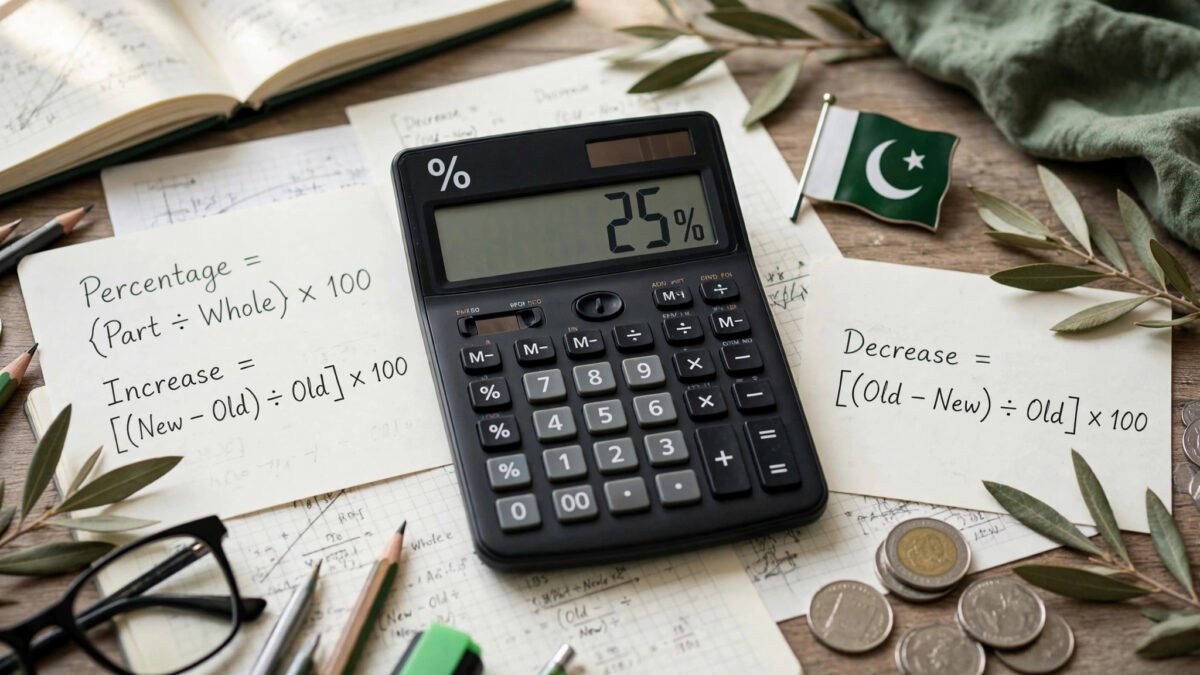
سب سے بنیادی فارمولا یہ ہے:
فیصد = (حصہ ÷ کل) × 100
یعنی جو حصہ آپ کے پاس ہے اسے کل سے تقسیم کریں اور 100 سے ضرب دے دیں۔ بس! اب اسے مثالوں سے سمجھتے ہیں۔
بنیادی فارمولے (Core Formulas)
فیصد کے تین بنیادی حساب ہیں، جن کے فارمولے درج ذیل ہیں:
- 1. فیصد معلوم کرنا: فیصد = (حصہ ÷ کل) × 100
- 2. حصہ معلوم کرنا: حصہ = (فیصد ÷ 100) × کل
- 3. کل معلوم کرنا: کل = (حصہ ÷ فیصد) × 100
ان تینوں فارمولوں سے آپ فیصد کا ہر سوال حل کر سکتے ہیں۔ اب ہر فارمولے کی عملی مثال دیکھتے ہیں۔
مثال 1: امتحان کے نمبرات (فیصد نکالنا)
ایک طالب علم نے بورڈ کے امتحان میں 1100 میں سے 850 نمبر حاصل کیے۔ فیصد کیا ہوگا؟
- مرحلہ 1: حصہ ÷ کل = 850 ÷ 1100 = 0.7727
- مرحلہ 2: 100 سے ضرب = 0.7727 × 100 = 77.27
- نتیجہ: 77.27% نمبر
پاکستان میں بورڈ کے نتائج اسی طرح فیصد میں بتائے جاتے ہیں۔ یونیورسٹی داخلوں میں میرٹ بھی فیصد کی بنیاد پر بنتا ہے۔
مثال 2: دکان پر رعایت (Discount)
بازار میں ایک قمیض کی قیمت 5,000 روپے ہے اور دکاندار 20% رعایت دے رہا ہے۔ حتمی قیمت کیا ہوگی؟
یہاں ہمیں “حصہ معلوم کرنا” والا فارمولا استعمال کرنا ہے: حصہ = (فیصد ÷ 100) × کل
- مرحلہ 1: رعایت کی رقم = (20 ÷ 100) × 5000 = 0.20 × 5000 = 1,000 روپے
- مرحلہ 2: حتمی قیمت = 5000 − 1000 = 4,000 روپے
جلدی طریقہ: 100% − 20% = 80% ادا کرنا ہے۔ (80 ÷ 100) × 5000 = 0.80 × 5000 = 4,000 روپے۔ دونوں طریقوں سے جواب ایک ہی ہے۔
بازار میں مول تول کا ٹوٹکا: دکاندار اکثر “50% تک رعایت” لکھتے ہیں — “تک” کا مطلب ہے کہ رعایت 50% سے کم بھی ہو سکتی ہے۔ اصل رعایت ہمیشہ بل پر چیک کریں اور خود حساب کر کے تصدیق کریں۔
مثال 3: تنخواہ میں اضافہ (Salary Increase)
ایک ملازم کی تنخواہ 50,000 روپے ہے اور کمپنی 10% اضافہ دے رہی ہے۔ نئی تنخواہ کیا ہوگی؟
- مرحلہ 1: اضافے کی رقم = (10 ÷ 100) × 50000 = 0.10 × 50000 = 5,000 روپے
- مرحلہ 2: نئی تنخواہ = 50000 + 5000 = 55,000 روپے
جلدی طریقہ: 100% + 10% = 110%۔ (110 ÷ 100) × 50000 = 1.10 × 50000 = 55,000 روپے۔
مثال 4: فیصد تبدیلی (Percentage Change)
فیصد تبدیلی کا فارمولا بتاتا ہے کہ کوئی قیمت کتنے فیصد بڑھی یا گھٹی:
فیصد تبدیلی = ((نئی قیمت − پرانی قیمت) ÷ پرانی قیمت) × 100
مثال: پٹرول کی قیمت 260 روپے سے بڑھ کر 286 روپے ہو گئی۔ اضافہ کتنے فیصد ہوا؟
- مرحلہ 1: فرق = 286 − 260 = 26 روپے
- مرحلہ 2: (26 ÷ 260) × 100 = 0.10 × 100 = 10% اضافہ
مثال (کمی): ایک موبائل فون 40,000 روپے سے کم ہو کر 32,000 روپے کا ہو گیا۔
- فرق = 40000 − 32000 = 8,000 روپے
- (8000 ÷ 40000) × 100 = 20% کمی
مثال 5: بینک کا منافع (Profit)
آپ نے بینک میں 100,000 روپے ایک سال کے لیے رکھے اور بینک سالانہ 15% منافع دے رہا ہے۔ ایک سال بعد کتنی رقم ملے گی؟
- منافع = (15 ÷ 100) × 100000 = 15,000 روپے
- کل رقم = 100000 + 15000 = 115,000 روپے
نوٹ: یہ سادہ منافع کا حساب ہے۔ اگر منافع ہر ماہ یا سہ ماہی جمع ہوتا ہے (compound profit) تو رقم تھوڑی زیادہ ہوگی۔ بینک سے ہمیشہ پوچھیں کہ منافع سادہ ہے یا مرکب، اور ٹیکس کٹوتی کے بعد خالص منافع کتنا ملے گا۔
روزمرہ زندگی میں فیصد کے استعمال
بورڈ کے امتحانات اور میرٹ
میٹرک اور انٹر کے نتائج فیصد میں آتے ہیں۔ یونیورسٹیوں میں داخلے کا میرٹ بھی فیصد کی بنیاد پر بنتا ہے — مثلاً میڈیکل کالج کے لیے 90% سے اوپر میرٹ جاتا ہے۔ اپنے نمبروں کا فیصد خود نکالنا سیکھیں تاکہ میرٹ کا اندازہ لگا سکیں۔
بازار اور سودے بازی
دکاندار “20% چھوٹ”، “خریدیں 2 پائیں 1 مفت” جیسے نعرے لگاتے ہیں۔ “1 مفت” کا مطلب تقریباً 33% رعایت ہے (3 چیزوں کی قیمت میں 2 کی ادائیگی)۔ حساب خود کریں — اکثر “بڑی رعایت” اتنی بڑی نہیں ہوتی جتنی لگتی ہے۔
ٹیکس اور کٹوتیاں
تنخواہ سے انکم ٹیکس، بینک منافع سے ودہولڈنگ ٹیکس — یہ سب فیصد میں کٹتے ہیں۔ اپنی پے سلپ پر ٹیکس کی شرح چیک کریں اور خود حساب کر کے دیکھیں کہ کٹوتی درست ہے یا نہیں۔
ٹپ اور سروس چارجز
ریسٹورنٹ میں بل پر 10-15% ٹپ دینا عام ہے۔ بل 3,000 روپے ہو تو 10% ٹپ = 300 روپے۔ یہ حساب ذہن میں کرنا آسان ہے۔
ذہنی حساب کے آسان ٹوٹکے
- 10% نکالنا: عدد کو 10 سے تقسیم کر دیں۔ 5000 کا 10% = 500۔
- 5% نکالنا: پہلے 10% نکالیں پھر آدھا کریں۔ 5000 کا 5% = 250۔
- 20% نکالنا: 10% کا دگنا۔ 5000 کا 20% = 1000۔
- 25% نکالنا: عدد کو 4 سے تقسیم کریں۔ 5000 کا 25% = 1250۔
- 50% نکالنا: عدد کا آدھا۔ 5000 کا 50% = 2500۔
- 15% نکالنا: 10% + 5% جمع کریں۔ 5000 کا 15% = 500 + 250 = 750۔
عام غلطیاں
- غلط بنیاد: فیصد ہمیشہ اصل (پرانی) قیمت پر نکالیں، نئی قیمت پر نہیں۔ 260 سے 286 کا اضافہ 10% ہے، لیکن 286 سے 260 کی کمی 9.09% ہے (26 ÷ 286) — بنیاد بدلنے سے جواب بدلتا ہے۔
- فیصد پوائنٹس بمقابلہ فیصد: اگر شرح 10% سے بڑھ کر 15% ہو تو یہ 5 فیصد پوائنٹس کا اضافہ ہے، لیکن شرح میں 50% اضافہ ہے۔ خبروں میں یہ فرق اکثر الجھاتا ہے۔
- لگاتار رعایتوں کو جمع کرنا: 20% پھر 10% رعایت کا مطلب 30% نہیں۔ 5000 پر پہلے 20% = 4000، پھر 10% = 3600۔ کل رعایت 28% ہوئی، 30% نہیں۔
اکثر پوچھے جانے والے سوالات (FAQ)
فیصد نکالنے کا فارمولا کیا ہے؟
فیصد = (حصہ ÷ کل) × 100۔ مثال: 850 ÷ 1100 × 100 = 77.27%۔
کسی عدد کا اتنے فیصد کیسے نکالیں؟
حصہ = (فیصد ÷ 100) × کل۔ مثال: 5000 کا 20% = 0.20 × 5000 = 1000۔
رعایت کے بعد قیمت کیسے نکالیں؟
پہلے رعایت کی رقم نکالیں پھر اصل قیمت سے گھٹائیں۔ یا جلدی طریقہ: (100 − رعایت%) کو 100 سے تقسیم کر کے اصل قیمت سے ضرب دیں۔
فیصد اضافہ اور فیصد کمی کا فارمولا کیا ہے؟
((نئی قیمت − پرانی قیمت) ÷ پرانی قیمت) × 100۔ مثبت جواب اضافہ، منفی جواب کمی بتاتا ہے۔
20% پھر 10% رعایت کل کتنی بنتی ہے؟
30% نہیں بلکہ 28%۔ لگاتار فیصد جمع نہیں ہوتے — ہر رعایت نئی قیمت پر لگتی ہے۔
ٹپ کا حساب کیسے کریں؟
بل کا 10% نکالیں (10 سے تقسیم)۔ 3000 کے بل پر 300 روپے ٹپ بنتی ہے۔
میرٹ کا فیصد کیسے نکلتا ہے؟
حاصل کردہ نمبر ÷ کل نمبر × 100۔ یونیورسٹی داخلے میں اکثر میٹرک اور انٹر کے فیصد کو ملا کر میرٹ بنتا ہے۔
نتیجہ (Conclusion)
فیصد کا حساب ہماری روزمرہ زندگی کا لازمی حصہ ہے — امتحان کے نمبر ہوں، بازار کی رعایت، تنخواہ میں اضافہ یا بینک کا منافع۔ تین بنیادی فارمولے (فیصد نکالنا، حصہ نکالنا، کل نکالنا) یاد کر لیں اور اوپر دی گئی مثالوں سے مشق کریں۔ ذہنی حساب کے ٹوٹکے (10%، 25%، 50%) آپ کو بازار میں فوری فیصلے کرنے میں مدد دیں گے۔ اور یاد رکھیں: لگاتار رعایتیں جمع نہیں ہوتیں اور فیصد ہمیشہ صحیح بنیاد پر نکالیں۔
مزید عملی مثالیں
مثال — دکاندار کا منافع: ایک دکاندار نے جوتے 2,000 روپے میں خریدے اور 2,500 روپے میں بیچے۔ منافع کا فیصد کیا ہے؟ منافع = 2500 − 2000 = 500 روپے۔ فیصد = (500 ÷ 2000) × 100 = 25% منافع۔ نوٹ کریں کہ فیصد خرید قیمت (لاگت) پر نکالا گیا، فروخت قیمت پر نہیں — یہ کاروبار کا درست طریقہ ہے۔
مثال — نمبروں سے کل نمبر: ایک طالب علم نے 77.27% نمبر حاصل کیے اور اس کے نمبر 850 ہیں۔ کل نمبر کتنے تھے؟ فارمولا: کل = (حصہ ÷ فیصد) × 100 = (850 ÷ 77.27) × 100 = 1100۔ جواب: 1100 نمبر۔
مثال — بجلی کے بل میں اضافہ: پچھلے مہینے بل 8,000 روپے آیا، اس مہینے 9,600 روپے۔ اضافہ = (9600 − 8000) ÷ 8000 × 100 = 1600 ÷ 8000 × 100 = 20% اضافہ۔
مثال — سیل میں دو رعایتیں: ایک سوٹ کی قیمت 8,000 روپے، پہلے 25% رعایت پھر اضافی 10% رعایت۔ پہلی رعایت کے بعد: 8000 × 0.75 = 6000 روپے۔ دوسری رعایت: 6000 × 0.90 = 5400 روپے۔ کل رعایت = 8000 − 5400 = 2600 روپے، یعنی 32.5% — نہ کہ 35%۔
فیصد اور تناسب کا تعلق
فیصد دراصل ایک خاص تناسب ہے جس کی بنیاد 100 ہے۔ “20 فیصد” کا مطلب ہے “100 میں سے 20″۔ یہی وجہ ہے کہ فیصد کو کسر (fraction) یا اعشاریہ (decimal) میں بھی لکھا جا سکتا ہے:
- 20% = 20/100 = 1/5 = 0.20
- 25% = 25/100 = 1/4 = 0.25
- 50% = 50/100 = 1/2 = 0.50
- 75% = 75/100 = 3/4 = 0.75
- 12.5% = 12.5/100 = 1/8 = 0.125
حساب میں آسانی کے لیے فیصد کو اعشاریہ میں بدل کر ضرب دیں — یہی وہ طریقہ ہے جو اوپر کی تمام مثالوں میں استعمال ہوا۔
بچوں کو فیصد کیسے سکھائیں؟
والدین اور اساتذہ کے لیے چند آسان طریقے:
- 100 روپے کے نوٹ کی مثال دیں — 10% یعنی 10 روپے، بچہ فوراً سمجھ جائے گا۔
- پیزا یا کیک کے ٹکڑوں سے فیصد سمجھائیں — آدھا پیزا = 50%۔
- بچے کے اپنے امتحانی نمبروں کا فیصد اس کے ساتھ مل کر نکالیں۔
- بازار لے جا کر رعایت والے بورڈ پڑھوائیں اور حساب کرنے کو کہیں۔
Percentage Calculator: How to Find Percentages? (Pakistan Guide)
Percentages are everywhere in daily life — exam marks, shop discounts, salary increments, bank profit, and tax calculations. But many people forget the basic formulas for working with percentages. In this article we explain all the core percentage formulas in simple language, with everyday Pakistani examples.
The most basic formula is:
Percentage = (part ÷ whole) × 100
That is, divide the part you have by the whole, then multiply by 100. That is all there is to it! Let us understand it through examples.
Core Formulas
There are three basic percentage calculations, with these formulas:
- 1. Finding the percentage: Percentage = (part ÷ whole) × 100
- 2. Finding the part: Part = (percentage ÷ 100) × whole
- 3. Finding the whole: Whole = (part ÷ percentage) × 100
With these three formulas you can solve any percentage problem. Now let us see a worked example of each.
Example 1: Exam Marks (Finding the Percentage)
A student scored 850 out of 1100 in the board exam. What is the percentage?
- Step 1: part ÷ whole = 850 ÷ 1100 = 0.7727
- Step 2: multiply by 100 = 0.7727 × 100 = 77.27
- Result: 77.27% marks
Board results in Pakistan are reported this way, and university admission merit is also built on percentages.
Example 2: Shop Discount
A shirt costs Rs 5,000 in the bazaar and the shopkeeper offers 20% off. What is the final price?
Here we use the “finding the part” formula: Part = (percentage ÷ 100) × whole
- Step 1: discount amount = (20 ÷ 100) × 5000 = 0.20 × 5000 = Rs 1,000
- Step 2: final price = 5000 − 1000 = Rs 4,000
Quick method: you pay 100% − 20% = 80%. (80 ÷ 100) × 5000 = 0.80 × 5000 = Rs 4,000. Both methods give the same answer.
Bazaar bargaining tip: Shopkeepers often write “up to 50% off” — “up to” means the discount can be less than 50%. Always check the actual discount on the bill and verify it with your own calculation.
Example 3: Salary Increase
An employee earns Rs 50,000 and the company gives a 10% raise. What is the new salary?
- Step 1: raise amount = (10 ÷ 100) × 50000 = 0.10 × 50000 = Rs 5,000
- Step 2: new salary = 50000 + 5000 = Rs 55,000
Quick method: 100% + 10% = 110%. (110 ÷ 100) × 50000 = 1.10 × 50000 = Rs 55,000.
Example 4: Percentage Change
The percentage-change formula tells you by what percent a price rose or fell:
Percentage change = ((new value − old value) ÷ old value) × 100
Example: The petrol price rose from Rs 260 to Rs 286. By what percent did it increase?
- Step 1: difference = 286 − 260 = Rs 26
- Step 2: (26 ÷ 260) × 100 = 0.10 × 100 = 10% increase
Example (decrease): A mobile phone dropped from Rs 40,000 to Rs 32,000.
- Difference = 40000 − 32000 = Rs 8,000
- (8000 ÷ 40000) × 100 = 20% decrease
Example 5: Bank Profit
You keep Rs 100,000 in a bank for one year and the bank pays 15% annual profit. How much will you get after a year?
- Profit = (15 ÷ 100) × 100000 = Rs 15,000
- Total = 100000 + 15000 = Rs 115,000
Note: this is simple profit. If profit compounds monthly or quarterly, the amount will be slightly higher. Always ask the bank whether the profit is simple or compound, and how much you net after tax deduction.
Percentages in Everyday Life
Board Exams and Merit
Matric and Intermediate results come as percentages. University admission merit is also percentage-based — for example, medical college merit goes above 90%. Learn to compute your own percentage to estimate merit.
Shopping and Bargaining
Shopkeepers advertise “20% off” or “buy 2 get 1 free.” “Get 1 free” means roughly a 33% discount (paying for 2 out of 3 items). Do the math yourself — the “big discount” is often not as big as it looks.
Taxes and Deductions
Income tax from salaries and withholding tax on bank profit are all deducted as percentages. Check the tax rate on your payslip and verify the deduction with your own calculation.
Tips and Service Charges
A 10–15% tip on restaurant bills is common. On a Rs 3,000 bill, a 10% tip = Rs 300. Easy to compute mentally.
Mental-Math Shortcuts
- 10% of a number: divide by 10. 10% of 5000 = 500.
- 5%: find 10%, then halve it. 5% of 5000 = 250.
- 20%: double the 10%. 20% of 5000 = 1000.
- 25%: divide by 4. 25% of 5000 = 1250.
- 50%: halve the number. 50% of 5000 = 2500.
- 15%: add 10% + 5%. 15% of 5000 = 500 + 250 = 750.
More Worked Examples
Example — shopkeeper’s profit: A shopkeeper bought shoes for Rs 2,000 and sold them for Rs 2,500. What is the profit percentage? Profit = 2500 − 2000 = Rs 500. Percentage = (500 ÷ 2000) × 100 = 25% profit. Note the percentage is computed on the purchase price (cost), not the selling price — that is the correct business method.
Example — finding the total from marks: A student scored 77.27% with 850 marks. What were the total marks? Formula: whole = (part ÷ percentage) × 100 = (850 ÷ 77.27) × 100 = 1100. Answer: 1100 marks.
Example — electricity bill rise: Last month’s bill was Rs 8,000; this month Rs 9,600. Increase = (9600 − 8000) ÷ 8000 × 100 = 1600 ÷ 8000 × 100 = 20% increase.
Example — double discount in a sale: A suit costs Rs 8,000, first 25% off then an extra 10% off. After the first discount: 8000 × 0.75 = Rs 6,000. Second discount: 6000 × 0.90 = Rs 5,400. Total discount = 8000 − 5400 = Rs 2,600, i.e., 32.5% — not 35%.
Percentages, Fractions and Decimals
A percentage is simply a ratio with base 100. “20 percent” means “20 out of 100.” That is why a percentage can also be written as a fraction or decimal:
- 20% = 20/100 = 1/5 = 0.20
- 25% = 25/100 = 1/4 = 0.25
- 50% = 50/100 = 1/2 = 0.50
- 75% = 75/100 = 3/4 = 0.75
- 12.5% = 12.5/100 = 1/8 = 0.125
For easy calculation, convert the percentage to a decimal and multiply — the method used in all examples above.
Common Mistakes
- Wrong base: Always compute the percentage on the original (old) value, not the new one. A rise from 260 to 286 is 10%, but a fall from 286 to 260 is 9.09% (26 ÷ 286) — changing the base changes the answer.
- Percentage points vs percent: If a rate rises from 10% to 15%, that is a 5-percentage-point increase, but a 50% increase in the rate. News reports often confuse the two.
- Adding successive discounts: 20% then 10% off is not 30%. On 5000: first 20% → 4000, then 10% → 3600. The total discount is 28%, not 30%.
Teaching Percentages to Children
A few easy methods for parents and teachers:
- Use a 100-rupee note as an example — 10% is Rs 10; a child grasps it instantly.
- Explain with pizza or cake slices — half a pizza = 50%.
- Compute the child’s own exam percentage together.
- Take them to the bazaar, read discount boards and ask them to do the math.
Frequently Asked Questions (FAQ)
What is the formula for finding a percentage?
Percentage = (part ÷ whole) × 100. Example: 850 ÷ 1100 × 100 = 77.27%.
How do I find a percent of a number?
Part = (percentage ÷ 100) × whole. Example: 20% of 5000 = 0.20 × 5000 = 1000.
How do I find the price after discount?
First find the discount amount, then subtract from the original price. Or the quick way: multiply the original price by (100 − discount%) ÷ 100.
What is the formula for percentage increase and decrease?
((new value − old value) ÷ old value) × 100. A positive answer is an increase; negative is a decrease.
Do 20% then 10% off add up to 30%?
No — 28%. Successive percentages do not add; each discount applies to the new price.
How do I calculate a tip?
Find 10% of the bill (divide by 10). On a Rs 3,000 bill the tip is Rs 300.
How is admission merit percentage computed?
Obtained marks ÷ total marks × 100. Universities often combine Matric and Intermediate percentages for merit.
Conclusion
Percentage math is an essential part of daily life — exam marks, bazaar discounts, salary raises or bank profit. Memorise the three core formulas (finding the percentage, finding the part, finding the whole) and practise with the examples above. Mental-math shortcuts (10%, 25%, 50%) will help you make quick decisions in the bazaar. And remember: successive discounts do not add up, and always compute percentages on the correct base.